Vesta
1 VP per 10 sestertii (coins plus leftover goods: brick 3, food 4, tools 5, wine 6, cloth 7).
No house-style cap. Leftover sestertii and goods score at that rate. One card in the game (Senator).
This is a strategy guide for the base game of Concordia for either the Imperium / Italia maps at 2, 3, and 4 player counts.
| Italia | Imperium | |
|---|---|---|
| Players | 2–4 | 3–5 |
| Buildable cities | 25 | 30 |
| Provinces / Saturnus | 11 | 12 |
| Cities per province | 2 or 3 | 2 or 3 |
| City tokens used | 25, no D | 30 |
| City letters | A, B, C, E | A, B, C, D, E |
| Token setup | Shuffle 30, match letters, flip; D boxed | Shuffle 30, match letters, flip |
| Province bonus | Most valuable good (cloth 7, wine 6, tools 5, food 4, brick 3) | Most valuable good (cloth 7, wine 6, tools 5, food 4, brick 3) |
| Bonus marker reverse | 2 sestertii, cloth 1. Cash Prefect takes that sum, then flips all back | 2 sestertii, cloth 1. Cash Prefect takes that sum, then flips all back |
| Houses | 15 | 15 |
| Colonists | 3 land + 3 sea | 3 land + 3 sea |
| Storehouse | 12 | 12 |
| Starting seven | 7 cards. P1 5 sestertii, +1 later seats. Last: Praefectus Magnus | 7 cards. P1 5 sestertii, +1 later seats. Last: Praefectus Magnus |
| Cards / Concordia | 30 for sale (I–V), display 7. Concordia 7 VP | 30 for sale (I–V), display 7. Concordia 7 VP |
| Goods types | 5 | 5 |
Play one personality card per turn. At the end, every card you own (hand + discard) multiplies its god. The board is how you feed those multipliers.
1 VP per 10 sestertii (coins plus leftover goods: brick 3, food 4, tools 5, wine 6, cloth 7).
No house-style cap. Leftover sestertii and goods score at that rate. One card in the game (Senator).
1 VP per house in a non-brick city.
Max 15: 1 VP × 15 houses. Only non-brick cities count; brick houses need the Mason.
1 VP per province with at least one of your houses.
Max 12 Imperium / 11 Italia: 1 VP × number of provinces (Imperium 12, Italia 11). A second house in the same province adds nothing here.
2 VP per goods type your houses produce. Count each type once.
Max 10: 2 VP × 5 goods types (brick, food, tools, wine, cloth). Salt is not in the base game.
2 VP per colonist on the board (land or sea).
Max 12: 2 VP × 6 colonists (3 land + 3 sea). Starting two in Roma already count.
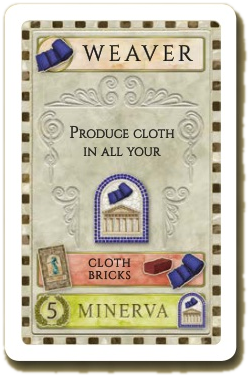
Each specialist pays its printed rate for houses of that city type: Mason 3 (brick), Farmer 3 (food), Smith 3 (tools), Vintner 4 (wine), Weaver 5 (cloth).
No single cap. Each specialist is its rate × houses of that city type. Specialists do not multiply each other.
Whoever buys the last market card, or builds their 15th house, takes Concordia (7 VP). Everyone else gets one last turn. Ties go to Praefectus Magnus, or the tied player who would receive it next.
Mercator trades up to two types. You cannot discard goods. Storehouse is 12 spaces. Mercurius scores 2 VP per goods type your houses produce (max 10). Prefect production and the province bonus are how you get them. Architect coins for food / tools / wine / cloth cities are 2 / 3 / 4 / 5 and multiply by houses that will be in the city after you build. Senator pays the printed cost plus extras under the slot (a question mark is any good). Consul ignores extras. After a buy, remaining cards slide left; extras stay with the slot, so the right stays expensive. Cloth (bank 7) is printed under those right-hand slots.
| Good | Used for |
|---|---|
 Brick (bank 3) Brick (bank 3) | Non-brick cities: 1 brick + that city’s good + coins. Brick cities: 1 food + 1 sestertius. Printed on Farmer, Smith, Vintner, Weaver. Mason (Minerva 3); brick houses skip Jupiter without it. |
 Food (bank 4) Food (bank 4) | Pays brick cities. Colonists (Tribune in Roma, or Colonist card): 1 food + 1 tool each. Printed on Colonist, Mason, Farmer, and Diplomat (III and V). Farmer (Minerva 3). |
 Tools (bank 5) Tools (bank 5) | Other half of the colonist cost. Tool cities: 1 brick + 1 tool + 3 coins. Printed on Architect, Smith, and Diplomat (I and IV). Smith (Minerva 3). |
 Wine (bank 6) Wine (bank 6) | Wine cities: 1 brick + 1 wine + 4 coins. Printed on Prefect, Mercator, and Vintner. Vintner (Minerva 4). Scarcer cities. Midgame you want a wine source so you are not buying wine from the bank to buy those cards. |
 Cloth (bank 7) Cloth (bank 7) | Cloth cities: 1 brick + 1 cloth + 5 coins. Printed on Consul and Weaver. Weaver (Minerva 5). Extra under the right-hand slots: Senator pays it, Consul skips extras. Highest bank / Vesta value, so those extras sting. Fewest cities. Any province with a cloth city bonuses cloth, so you can take cloth without living there. An early cloth house can sit un-Prefected. |
Tribune, Architect, Diplomat, Mercator, two Prefects, Senator. No Consul, no Colonist. Goods: 2 food, 1 each of brick, tools, wine, cloth. Storehouse is 12 spaces; 4 unused colonists plus those 6 goods leave 2 empty. Start player has 5 sestertii; each later player gets +1. Last player starts with Praefectus Magnus.
Click any card to enlarge it.
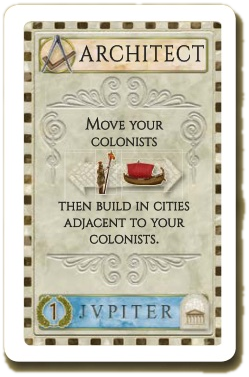

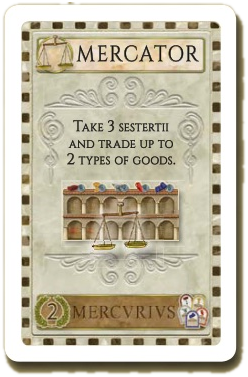
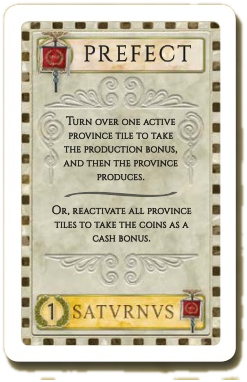
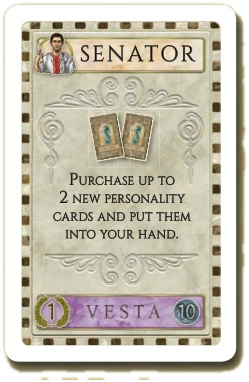
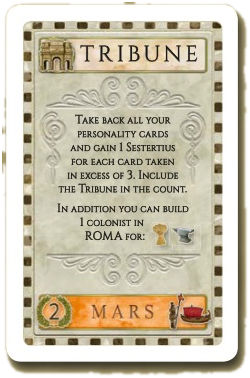
Look at the colored banner on each card. That is the god that scores. The number on the banner is the rate (Jupiter 1, Mars 2, Mercurius 2, Vesta 1 per 10).
Diplomat copies the face-up card on an opponent’s discard. You cannot copy a Diplomat or a Tribune. Praefectus Magnus doubles only the province bonus good, not city production and not cash. It passes to your right after a production Prefect; a cash Prefect keeps it. You must use it on production.
Extra Architects, Prefects, Mercators, Diplomats, and Colonists are more actions plus another god multiplier. Starting Diplomat is Jupiter. Decks I and III are Saturnus. Deck IV (4p) is Mercurius. Deck V is Mars (5p only). Purchased Mercator pays 5 sestertii instead of 3. Which decks sit in the market depends on seat count (below).

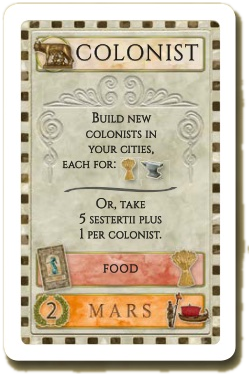
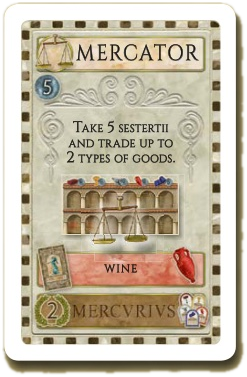
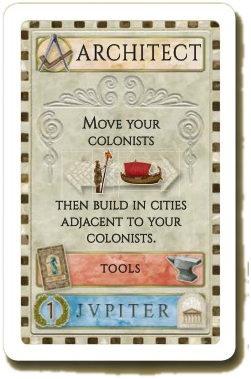

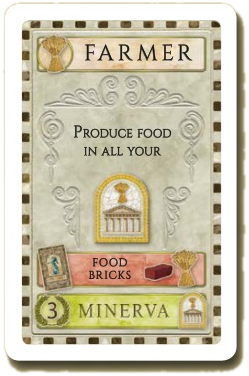
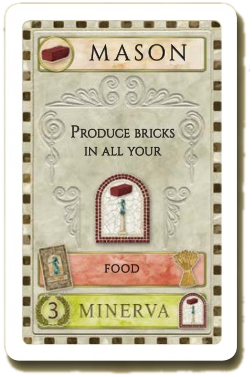
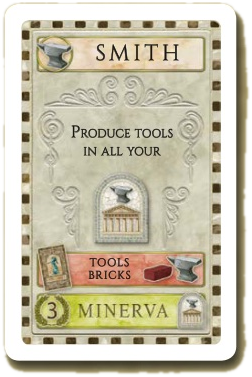
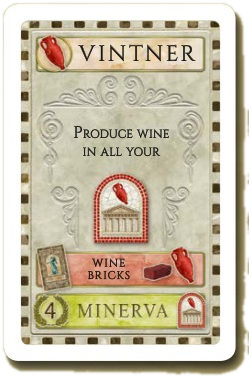
Every hand starts with 1 Vesta (Senator), 2 Jupiter (Architect and Diplomat), 2 Saturnus (Prefects), 1 Mercurius (Mercator), and 1 Mars (Tribune). Those are yours. The tables are the shared market. Jupiter and Saturnus are the thick stacks; they keep arriving as seats are added. Minerva is five unique specialists, all in by 2p. No Mercator in deck IV, so 4p does not add a Mercator. No Diplomat in deck II. Deck IV Diplomat is Mercurius; deck V is Mars (5p only).
| God | 2p | 3p | 4p |
|---|---|---|---|
| Jupiter | 3 | 5 | 7 |
| Saturnus | 3 | 5 | 6 |
| Mercurius | 2 | 3 | 4 |
| Mars | 2 | 3 | 4 |
| Minerva | 5 | 5 | 5 |
| Total for sale | 15 | 21 | 26 |
| Card | God | 2p | 3p | 4p |
|---|---|---|---|---|
| Architect | Jupiter | 2 | 3 | 4 |
| Consul | Jupiter | 1 | 2 | 3 |
| Prefect | Saturnus | 2 | 3 | 4 |
| Diplomat I, III | Saturnus | 1 | 2 | 2 |
| Diplomat IV | Mercurius | 0 | 0 | 1 |
| Mercator | Mercurius | 2 | 3 | 3 |
| Colonist | Mars | 2 | 3 | 4 |
| Farmer | Minerva | 1 | 1 | 1 |
| Mason | Minerva | 1 | 1 | 1 |
| Smith | Minerva | 1 | 1 | 1 |
| Vintner | Minerva | 1 | 1 | 1 |
| Weaver | Minerva | 1 | 1 | 1 |
Vesta is only the starting Senator. Starting Diplomat is Jupiter. Market I and III are Saturnus; IV is Mercurius (4p). V is Mars (5p only). Numbers are copies in the market, not counting the seven in your hand. Deck V is 5-player only.
Same rules at every count; the market is smaller at 2 and 3, so the contest for the same cards changes. Italia is the tighter 2–4 map (25 cities, Saturnus cap 11). Imperium is 3–5 (30 cities, cap 12).
| 2p | 3p | 4p | |
|---|---|---|---|
| Cards for sale | 15 (I–II) | 21 (I–III) | 26 (I–IV) |
| Consuls in the market | 1 | 2 | 3 |
| Market Diplomats | 1 | 2 | 3 |
| Starting money | 5 / 6 | 5 / 6 / 7 | 5 / 6 / 7 / 8 |
All five specialists are in decks I–II, so they exist at every count. Last player always starts with Praefectus Magnus.
Diplomat copies exactly one face-up card. Hold it for their Senator, Consul, Architect, or a Praefectus Magnus Prefect. If they Tribune, you have nothing to copy. The single Consul is contested; missing it hurts more than at 4p. Praefectus Magnus passes after a production Prefect and stays after a cash Prefect. Use production when the double bonus is a good you need and their storehouse is full or they have few houses in that province. Cities stay cheaper longer. First-in still matters, but 2×/3× coins show up less. The 15-card market empties fast, so 7 VP Concordia is a bigger share of a shorter score. Do not wait for them to flip your preferred province; they may never do so.
Two Diplomat targets, two Consuls, 21 cards. Praefectus Magnus rotates among three, so you hold it less often than at 2p and more than at 4p. Board crowding and coin multipliers start to matter. This is the count where copying the wrong Prefect fills two opponents. Sit in provinces both others want, or Prefect when only you receive the goods.
Three face-up cards for Diplomat almost every turn; extra Diplomats are better because you will actually play them. The third one (deck IV) scores Mercurius, not Saturnus. Three Consuls in the stack, but the row is more contested and extras on the right rise quickly. Cities fill: pay for first-in or pay 2×/3× later. Share other players’ Prefect production. Praefectus Magnus changes hands often. When it arrives, spend it on a bonus good you need, then let it go. More cards in the market means more Senator cycles; still buy two, and still watch who can empty the display.
Buy the personality card that matches the board you already have.
1 Consul: take an expensive personality card for only the printed cost. Hold Diplomat to copy one if you missed it. Only one exists at 2p; three at 4p.
2 Farmer: cheapest specialist to max. Food builds brick cities, food cities, and colonists, and those houses still count for Jupiter. Pairs with Mason: cheap houses and Saturnus.
3 Architect / Mercator: a second Architect or a 5-sestertii Mercator is another full cycle after you Tribune. Without a second Architect you get one build per Tribune cycle.
4 Colonist: Mars, extra storehouse space, and a sestertii option (5 + 1 per colonist on the board). Most colonists still come from Tribune; this card is often the money. Do not let one player collect every Mars card. It can also place colonists on cities you already own, not only Roma.
5 Mason: brick is required to build in non-brick cities. Brick houses do not score Jupiter, so do not fill brick cities unless the Mason is yours.
6 Diplomat: copy Senator, Consul, Architect, or a Praefectus Magnus Prefect. Starting copy is Jupiter. I and III score Saturnus; IV (4p) scores Mercurius. One target at 2p, three at 4p. Extras are worth more when the table is full.
7 Prefect: more Saturnus and more production. Fine, not a must-buy. At 4p, produce when other players flip provinces you share; at 2p you often have to flip your own.
8 Smith: tools pay for colonists and tool cities. Same 3 VP as Farmer/Mason, harder to pile up.
9 Weaver / Vintner: 5 and 4 VP look big; cloth and wine cities are scarce and expensive. Buy if you already live there. Cheap denial if the cloth or wine player would max it.